


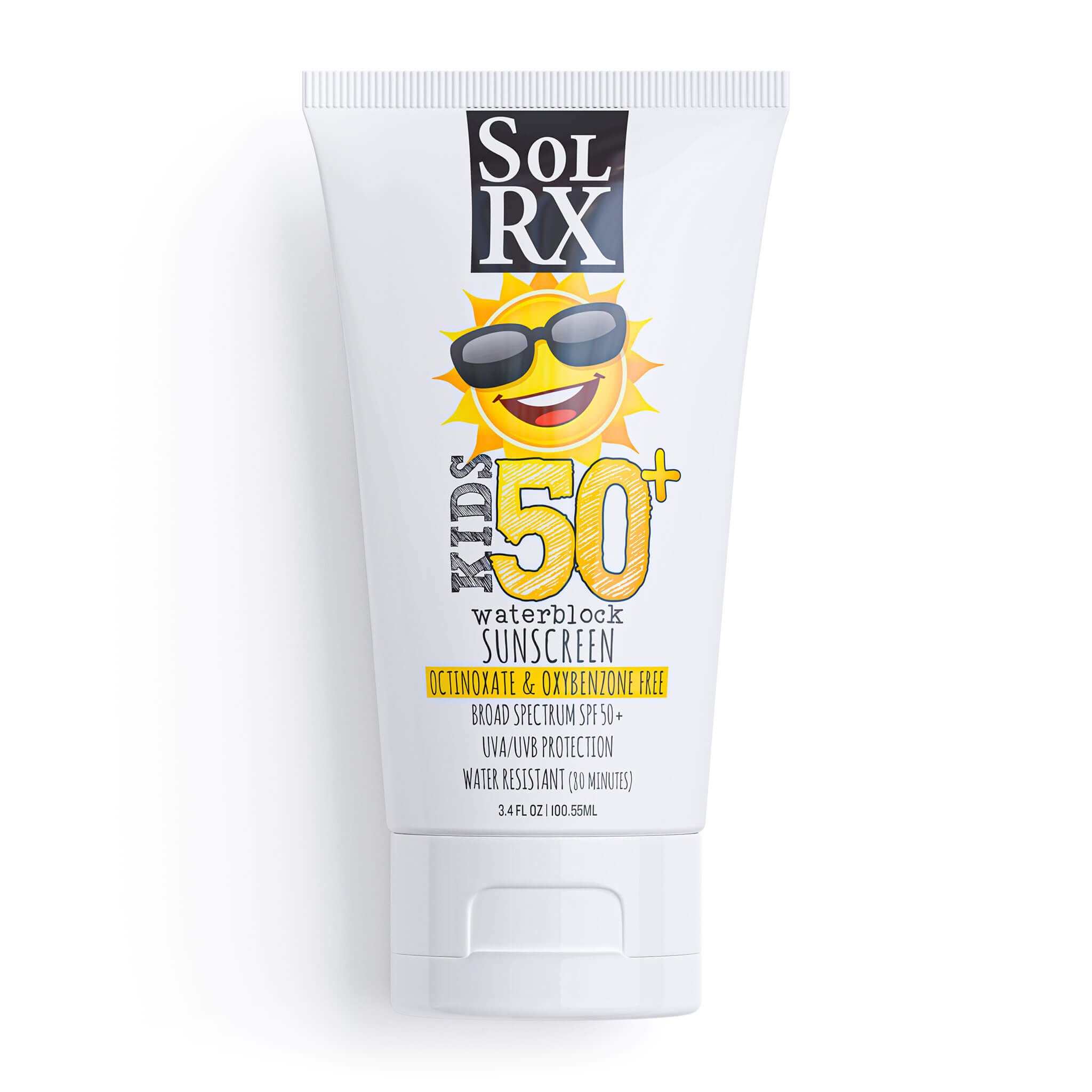
SolRX kids sunscreens are tear-free, reef-safe, and built for real outdoor use. Every formula is fragrance-free, hypoallergenic, and water resistant, with no oxybenzone and no octinoxate. Fast application, no eye sting, and protection that holds up through a full day at the pool or beach.

What Makes Kids Sunscreen Different From Adult Formulas
Children's skin is thinner and more reactive than adult skin. It absorbs ingredients more readily, responds more strongly to fragrance and chemical UV filters, and is more vulnerable to cumulative UV damage over a lifetime. Roughly a quarter of lifetime sun exposure happens before age 18, which means the sunscreen habits built in childhood have lasting implications for long-term skin health. Kids' formulas are engineered specifically for these differences: fragrance-free to reduce irritation risk, tear-free so full-face application is possible, and built with a balanced pH that won't sting sensitive skin or eyes. For parents choosing between adult and kids' sunscreen, the difference is not just marketing.
Why Tear-Free Formula Changes Everything
Sunscreen that stings the eyes makes application a battle and puts kids off wearing it altogether. A tear-free formula won't cause pain if it runs during swimming or sweating, which means parents can apply thoroughly to the forehead, cheeks, and the area around the eyes without hesitation. That single feature changes the entire experience of applying sunscreen to a moving, resistant child. Both SolRX kids formulas are tear-free. Apply to the face completely and without the anxiety of causing distress. Kids who don't associate sunscreen with eye pain are far easier to protect consistently.
Water Resistance That Holds Up Through Real Swimming
Most kids' sunscreens fail in the water. Standard formulas degrade after 40 to 80 minutes of immersion, and many do not perform reliably even to that rating under real ocean and pool conditions involving movement, saltwater, and repeated submersion. The SolRX Kids SPF 50 Waterblock Lotion uses an independently commissioned immersion test protocol that exceeded the FDA 80-minute standard. The result was SPF protection maintained after 8 continuous hours of water exposure. For kids who are in and out of the water all day, that bonding strength is the difference between real protection and a false sense of security. The water resistant sunscreen collection covers all SolRX formulas with tested water resistance for active use.
Reef-Safe Protection for Ocean Families
Oxybenzone and octinoxate, the two UV filters most associated with coral reef damage, are banned in Hawaii, Palau, and other reef-protected destinations. Every SolRX kids formula is oxybenzone-free and octinoxate-free, making both products fully compliant with Hawaii Act 104 and safe for ocean swimming. The protection you put on your child at the beach should be safe for the reef they are about to swim over. Teaching reef-safe habits early is one of the most lasting environmental lessons a family can build into outdoor life. The reef-safe sunscreen collection covers every SolRX formula that meets full reef-safe compliance standards.
SPF Level Guide for Kids
The American Academy of Dermatology recommends broad-spectrum SPF 30 or higher for all children. For full days at the beach, pool, or in sustained direct sun, SPF 50 or higher provides a stronger protective margin. SPF 50 blocks approximately 98 percent of UVB rays, compared to 97 percent for SPF 30. That difference compounds significantly across years of outdoor activity during childhood. SolRX kids formulas are SPF 50 and SPF 55+, appropriate for extended outdoor and active water use. High SPF also provides a practical safety margin for under-application, which is extremely common when applying sunscreen to children who won't hold still.
Sensitive Skin and Mineral Formulas for Children
Pediatric dermatologists increasingly recommend mineral-based sunscreens for young children, particularly for the face, because zinc oxide and titanium dioxide sit on the surface of the skin rather than absorbing into the bloodstream the way chemical UV filters can. For children with eczema, sensitive skin, or any existing skin condition, a fragrance-free mineral formula is the standard recommendation from both the American Academy of Dermatology and the National Eczema Association. SolRX kids formulas are hypoallergenic, fragrance-free, and formulated without the chemical filters most associated with skin reactions. For children whose sensitivity extends beyond standard sun care, the sensitive skin sunscreen collection covers formulas designed specifically for reactive and condition-prone skin.
Spray vs Lotion: Which Format Is Right?
Both formats protect effectively when applied correctly. The choice comes down to the situation and the child. The SPF 50 Waterblock Lotion is the right call for swim days, full-body coverage, toddlers and babies where controlled application matters, and any situation where you want tactile confirmation of coverage. Lotion lets you feel exactly where you have applied and where you have not. The SPF 55+ Continuous Spray works at 360 degrees and is the practical choice for moving targets, outdoor sports events, and reapplication on a child who has already run out of patience. One rule applies regardless of format: for the face, spray into the palm first and apply by hand. Never spray directly near the eyes or mouth.
How to Build a Sunscreen Routine That Actually Sticks
Apply 15 minutes before going outside so the formula bonds to skin before UV exposure begins. Use more than you think you need. Most parents apply far less than the recommended amount, which meaningfully reduces effective protection regardless of SPF rating. Cover the areas most commonly missed: ears, back of the neck, tops of the feet, and the backs of the hands. Reapply every two hours during outdoor activity and immediately after towel drying, regardless of how recently you last applied. Making sunscreen a non-negotiable part of any outdoor day is the single most important step. Kids who grow up wearing sunscreen consistently are far more likely to carry that habit into adulthood, when cumulative UV exposure starts to show its effects.
Key Takeaways
-
Every SolRX kids formula is reef-safe, tear-free, and Hawaii Act 104 compliant.
Both products are oxybenzone-free and octinoxate-free, making them safe for coral reef environments and ocean swimming worldwide. -
The Kids SPF 50 Waterblock Lotion is independently tested to maintain SPF after 8 hours of water immersion.
Standard kids' sunscreens degrade after 40 to 80 minutes in water. Waterblock technology was built for full days at the pool or beach, not just a quick splash. -
SolRX kids formulas are fragrance-free, hypoallergenic, and appropriate for children with sensitive or reactive skin.
Fragrance is the most common sunscreen irritant. Both SolRX kids products remove it entirely, along with oxybenzone, octinoxate, and parabens.
Sources
- American Academy of Dermatology. Sunscreen FAQs. AAD.org. 2024.
- American Academy of Pediatrics. Sun Safety: Information for Parents About Sunburn and Sunscreen. HealthyChildren.org. 2024.
- Skin Cancer Foundation. Sun Protection for Children. SkinCancer.org. 2024.
- U.S. Food and Drug Administration. Sunscreen: How to Help Protect Your Skin from the Sun. FDA.gov. 2023.
- Hawaii Department of Health. Act 104 Reef-Safe Sunscreen Law. Health.Hawaii.gov. 2021.
- National Oceanic and Atmospheric Administration. Skincare Chemicals and Coral Reefs. NOAA.gov. 2024.
- Environmental Working Group. EWG's Guide to Sunscreens. EWG.org. 2024.
- Centers for Disease Control and Prevention. Sun Safety. CDC.gov. 2024.
- National Cancer Institute. Skin Cancer Prevention. Cancer.gov. 2024.
- Pediatric Dermatology. Sunscreen Use in Children: Recommendations and Review. Wiley Online Library. 2022.
Frequently Asked Questions About Kids Sunscreen
What is the best sunscreen for kids?
The best sunscreen for kids is tear-free, fragrance-free, reef-safe, and water resistant for outdoor and pool use. SolRX Kids SPF 50 Waterblock Lotion offers independently tested 8-hour water resistance in a hypoallergenic, tear-free formula designed for young skin. The Kids SPF 55+ Continuous Spray provides fast 360-degree application for active kids who won't hold still. Both are oxybenzone-free, octinoxate-free, and Hawaii Act 104 compliant.
What SPF do kids need?
The American Academy of Dermatology recommends SPF 30 or higher for all children. For full days at the beach, pool, or in direct sun, SPF 50 or higher provides a stronger margin of protection. SPF 50 blocks approximately 98 percent of UVB rays compared to 97 percent for SPF 30. SolRX kids formulas are SPF 50 and SPF 55+, appropriate for extended outdoor and active water use.
Is mineral sunscreen safer for kids than chemical sunscreen?
Many pediatric dermatologists prefer mineral-based sunscreens for young children because zinc oxide and titanium dioxide sit on top of skin rather than absorbing into the bloodstream the way chemical UV filters can. Mineral formulas are also gentler on sensitive or reactive skin. The FDA classifies zinc oxide and titanium dioxide as Generally Recognized as Safe and Effective, the only sunscreen actives to hold that classification. For the face and hands, where absorption is highest, a mineral or zinc-based formula is a strong choice for kids.
At what age can kids start wearing sunscreen?
The American Academy of Pediatrics recommends avoiding sunscreen on babies under 6 months and using shade, clothing, and wide-brimmed hats instead. At 6 months, sunscreen can be introduced. Start with a small patch test on the inner arm before full application to check for any reaction. SolRX kids formulas are hypoallergenic and appropriate for children 6 months and older.
How much sunscreen should I apply to my child?
The standard recommendation is 1 ounce for a full adult body. For children, scale down proportionally based on size but err generously. Most parents apply far less than needed, which is the most common reason for sunburns. Don't forget ears, back of the neck, tops of feet, and anywhere bathing suit straps might shift. Apply 15 minutes before sun exposure to allow the formula to bond to skin properly.
How often should I reapply sunscreen on kids?
Every two hours during outdoor sun exposure, and immediately after towel drying. Kids lose track of time in the water, so build reapplication into the routine rather than relying on them to ask. Reapply after every time they dry off, regardless of how recently you last applied. Setting a phone reminder helps make this consistent on long beach or pool days.
Is spray sunscreen safe for kids?
Yes, with one important rule. Never spray sunscreen directly onto a child's face or near the mouth. Spray into your hand first and apply to the face by hand. For the body, spray formulas are practical for fast, full-coverage application on active kids. SolRX Kids SPF 55+ Continuous Spray is tear-free, reef-safe, and works at 360 degrees for complete coverage on moving children.
What makes a sunscreen tear-free for kids?
Tear-free means the formula will not sting if it runs into the eyes during swimming or sweating. This is achieved through milder ingredients and a balanced pH that does not irritate the delicate tissue around the eyes. SolRX kids formulas are tear-free, which makes full-face application possible without distress and allows children to swim comfortably without the formula burning their eyes.
Can kids use adult sunscreen?
In many cases, yes. The active SPF ingredients in adult formulas are often the same as in kids' formulas. The key practical differences are that kids' formulas are explicitly tear-free, hypoallergenic, and tested for young skin sensitivity. If an adult formula is fragrance-free and mineral-based, it is generally appropriate for children as well. For very young kids or children with sensitive skin, a dedicated kids' formula is the more reliable choice.
How do I apply sunscreen to a child who won't hold still?
Apply before excitement peaks, before you arrive at the beach or pool rather than once kids are already in motion. Spray formulas are faster for full-body coverage on moving targets. Make sunscreen a routine so it becomes expected rather than a surprise interruption. Some parents find counting or making it a game helps with toddlers. The most important thing is getting adequate coverage on all exposed areas, even if the child is wriggling.
What is the best sunscreen for kids with sensitive skin or eczema?
For kids with sensitive or reactive skin, look for a fragrance-free, hypoallergenic formula with no chemical UV filters that are known skin sensitizers. SolRX kids formulas are fragrance-free and hypoallergenic. For children with eczema or diagnosed skin conditions, consult a pediatric dermatologist before choosing a formula and patch test any new product on the inner arm for 24 to 48 hours before full application.
What is the best sunscreen for kids at the beach or pool?
For beach and pool days, you need a formula that handles sun, saltwater, and repeated water exposure. The SolRX Kids SPF 50 Waterblock Lotion is independently tested for 8-hour water resistance, reef-safe, and tear-free, built for exactly this environment. Apply 15 minutes before hitting the water, reapply after every towel dry, and cover ears, the back of the neck, and the tops of feet, which are the zones most often missed at the beach.
Is reef-safe sunscreen important for kids?
Yes, both for the environment and as a habit worth building early. Oxybenzone and octinoxate are banned in Hawaii and other reef-protected areas because of their documented impact on coral reef ecosystems. Every SolRX kids formula is oxybenzone-free, octinoxate-free, and Hawaii Act 104 compliant. Using reef-safe sunscreen with kids from the start builds awareness that carries forward into adult life.
What should I look for when buying sunscreen for kids?
Look for broad-spectrum SPF 50, tear-free formula, fragrance-free ingredients, and a minimum of 80-minute water resistance. Reef-safe compliance (oxybenzone-free and octinoxate-free) matters if the child swims in the ocean. Mineral zinc oxide formulas are the preferred choice of pediatric dermatologists for young children and those with sensitive skin. The formula that gets applied consistently every outdoor day will always outperform a theoretically superior formula that sits unused in the bag.

